Opal Patterns Explained: Harlequin, Pinfire, Rolling Flash and More
A cutter's guide to opal patterns, from harlequin and pinfire to rolling flash, broad flash and flagstone. What each one looks like and how pattern affects a stone.
About Opal · By Stephanie Caruana ·
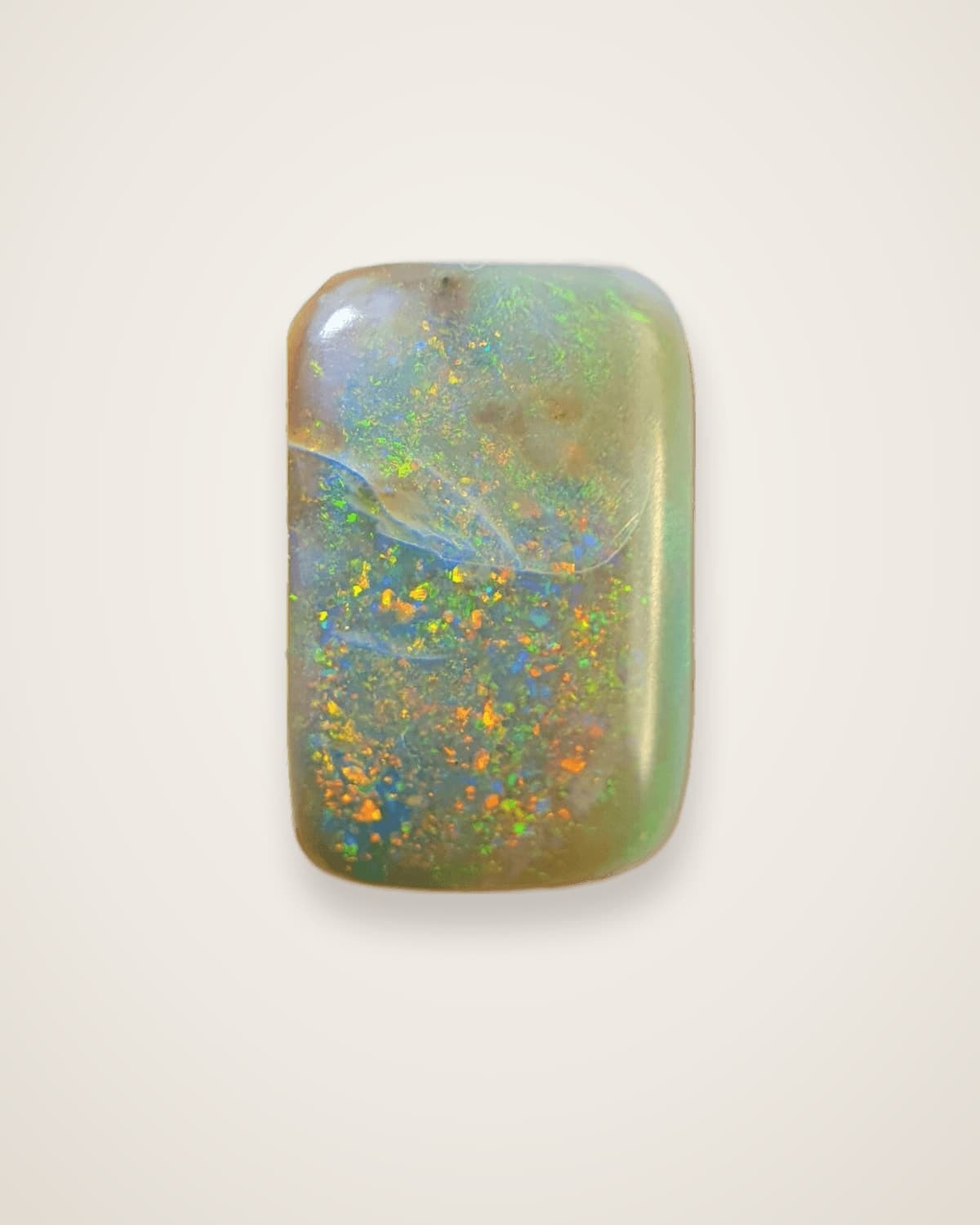
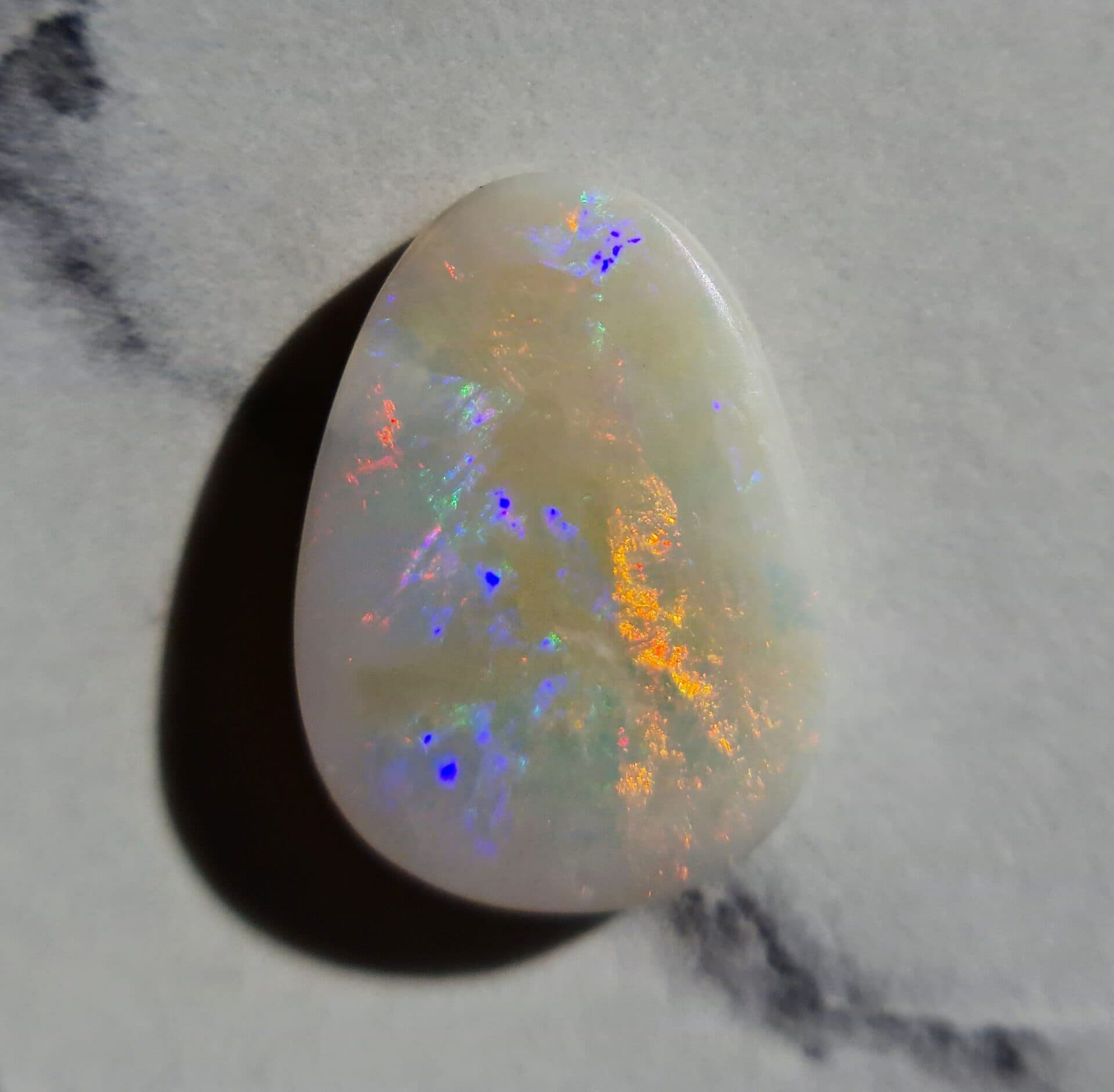
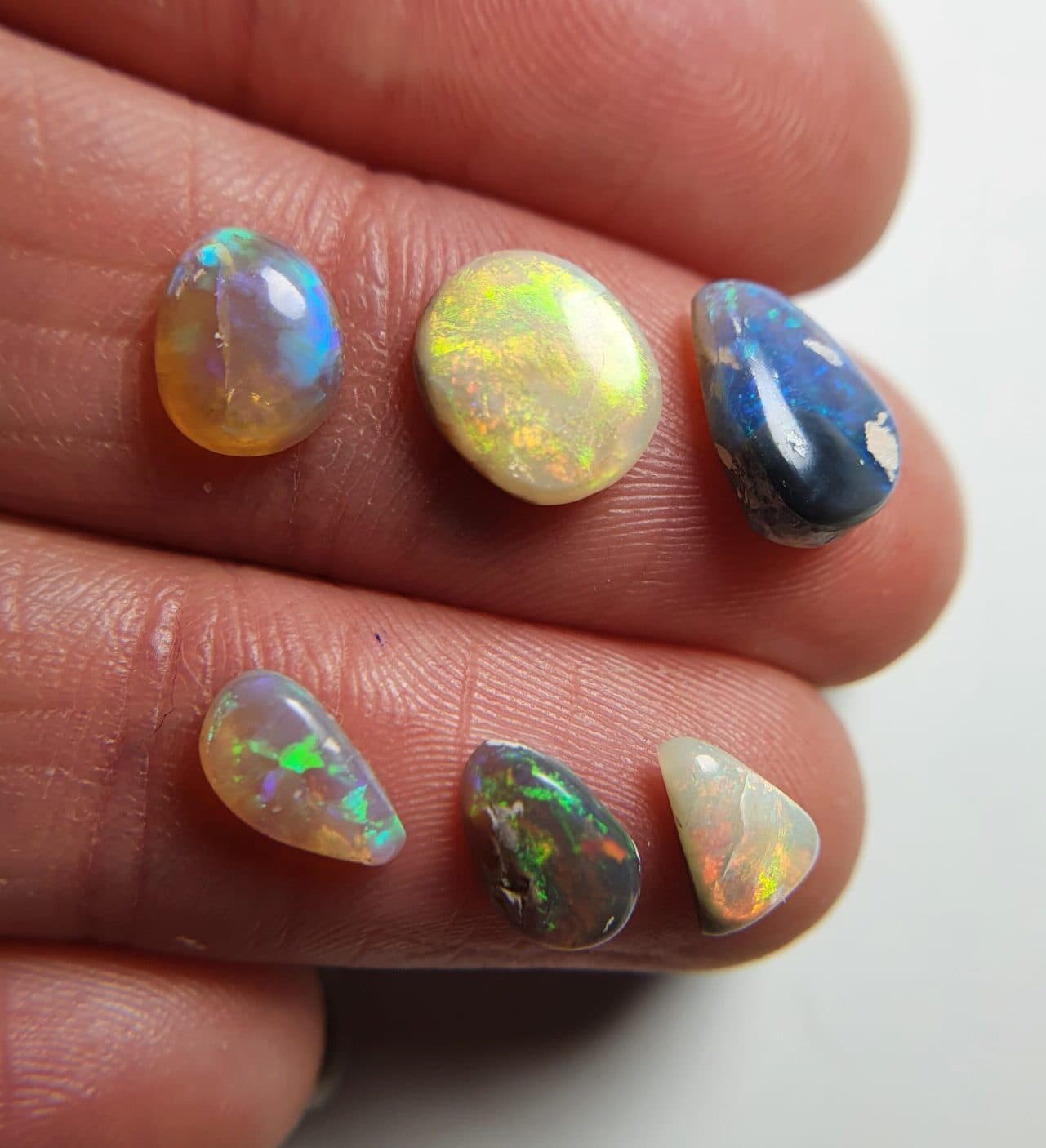
An opal's pattern is the shape its play of colour makes across the face. Harlequin shows large, angular patches of colour like a mosaic. Pinfire is tiny pinpoints of colour packed closely together. Rolling flash is a band of colour that rolls across the stone as you tilt it. Pattern is a big part of what makes each opal unique.
What is play of colour in opal?
Play of colour is the flashing spectral colour you see in precious opal as it moves. It comes from light bending around tiny silica spheres that are stacked in an orderly grid inside the stone.
Opal is made of silica and a little water. In common opal, or potch, the spheres are jumbled and irregular, so there's no play of colour. In precious opal, the spheres are even in size and neatly stacked, and that regular structure splits white light into colour.
The size of the spheres decides which colours you can see. Smaller spheres give blues and violets. Larger spheres can show the full range up to red, which is why red is the least common colour in opal.
The pattern is simply how those patches of ordered silica are arranged. Small, neat areas give a fine pattern. Large, uniform areas give big blocks or sheets of colour.
What are the main opal patterns?
Most opal patterns fall into a handful of named types. Many stones show a mix, and two cutters may describe the same stone a little differently, so treat these as a shared vocabulary rather than strict categories.
Harlequin
Harlequin is a pattern of large, distinct, roughly square or diamond-shaped patches of colour that sit side by side like a chequerboard. A true harlequin has clear edges between the patches and the patches are fairly even in size.
It's widely regarded as one of the rarest and most sought-after patterns. A lot of stones get called harlequin when they're really a broad pattern with some angular patches, so look closely at the photos.
Pinfire
Pinfire, sometimes called pinpoint, is made up of tiny dots of colour packed tightly together. It sparkles more than it flashes, and it looks lively from almost every angle.
I've had a few pinfire stones I still think about. One was a Mintabie semi black opal with such a gorgeous, sparkly pinfire pattern that I described it as a great stone for a bespoke piece. Pinfire is a lovely pattern for jewellery because it doesn't depend on catching the light at one exact angle.
Rolling flash
Rolling flash is a band or sheet of colour that seems to roll across the face as you tilt the stone. It moves like a wave of light from one side to the other.
It's mesmerising on video and in person, but hard to capture in a single photo. If a listing mentions rolling flash, ask for a video so you can see it move.
Broad flash
Broad flash shows large areas of colour that switch on and off as you change the angle. One moment a big part of the face lights up green, and the next it might be blue or go quiet.
Broad flash can be very bright, but some broad flash stones are directional, meaning they only light up from certain angles.
Flagstone
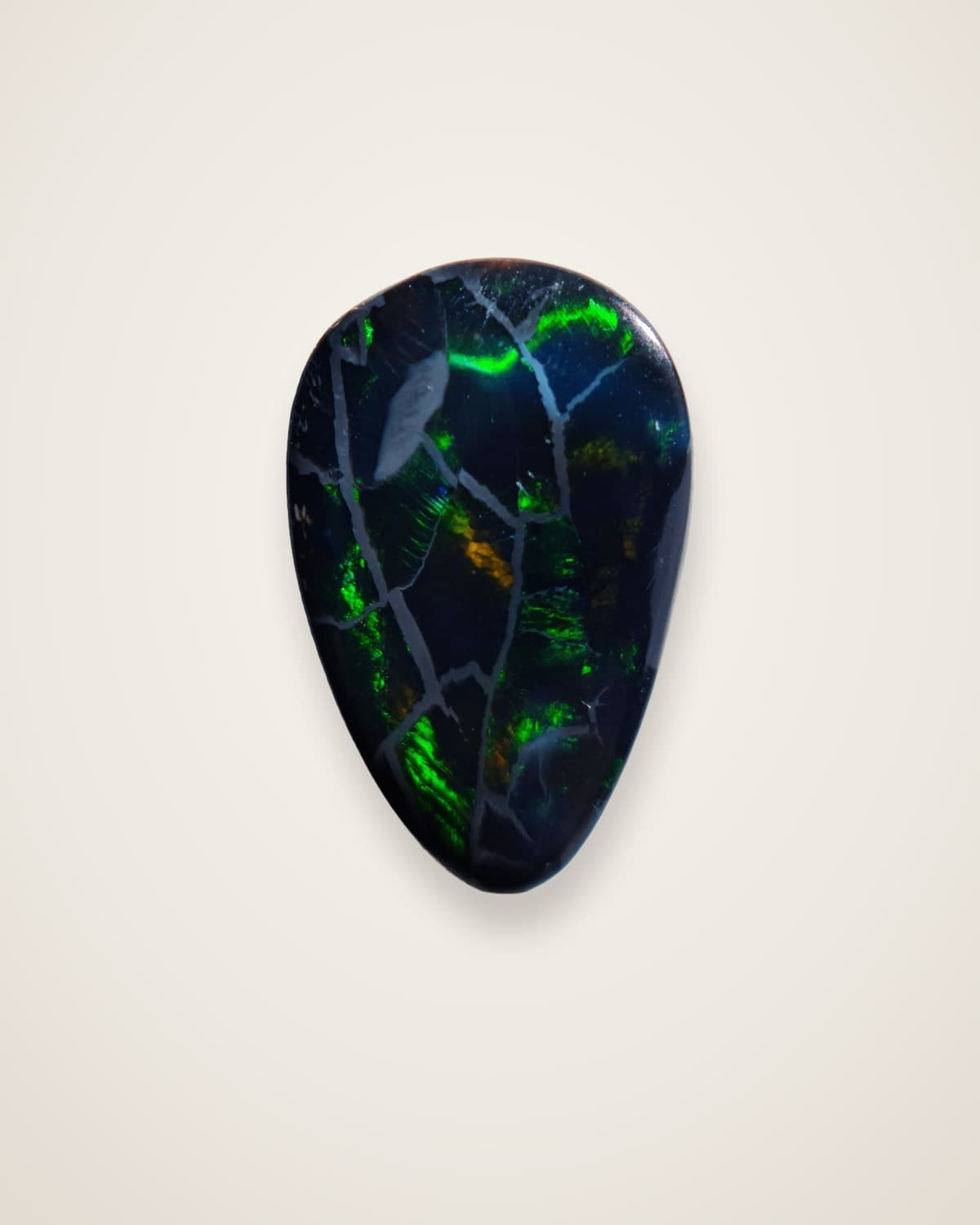
Flagstone is made of large, irregular patches of colour, a bit like crazy paving. It's often confused with harlequin, but the patches are uneven in shape and size, with less sharp edges.
One of the most unique opals I've cut was a leaf green black opal with a flagstone pattern, showing vibrant reds, yellows and greens. A good flagstone can be every bit as striking as harlequin.
Other pattern names you'll see
- Floral: colour in soft, petal-like shapes.
- Ribbon: parallel bands of colour, like lengths of ribbon.
- Straw: fine, thin streaks of colour lying like strands of straw.
- Chinese writing: thin, angular lines that look like script.
- Jigsaw: interlocking patches that look like puzzle pieces.
I've set a vibrant straw pattern white opal in a ring, and had an awesome jigsaw pattern crystal opal I couldn't decide whether to sell on its own or keep for a parcel.
Which opal pattern is the most valuable?
There's no single answer, because pattern is only one part of value. A clear harlequin is generally prized, but a bright pinfire or rolling flash with strong colour can be worth more than a dull harlequin.
Pattern works together with the other factors buyers look at:
- Body tone: how dark or light the background is, from N1 (black) to N9 (white).
- Brightness: how vivid the colour is.
- Colour: red across the face is the least common, then orange, then green and blue.
- Size, cut and condition: a thicker, well-domed stone with no cracks or sand inclusions counts for a lot.
A named pattern on its own won't make a stone special. A clear, bright pattern that covers the whole face, and looks good from many angles, will. My older post on how to value opal goes through these factors in more detail.
How do you see an opal's pattern properly?
Move it. Pattern only shows itself when the light, the stone and your eye change position relative to each other.
- Use daylight first. Natural light shows colour and pattern most honestly.
- Tilt and rotate the stone. Look at it face up, then rock it side to side and turn it a full circle.
- Check for directional colour. If the colour only appears at one angle, it will look quieter when worn.
- Look under a single bright light. A torch or downlight shows pinfire and rolling flash clearly.
- Ask for video when buying online. A still photo can't show a rolling flash or how a broad flash switches on and off.
Does the cut change the pattern?
The cut can't create a pattern, but it decides how much of it you see. A cutter chooses which way to orient the stone, how far to grind into the colour bar, and how high to dome the face.
Opal often grows in thin layers, and a single piece can show different patterns at different depths. I once had a big Coober Pedy white opal with three colour bars, each with a different pattern. Grind a little further and the face can change completely, which is both the joy and the stress of cutting.
Doming matters too. A good dome can spread a pinfire pattern across the face and make a rolling flash move more smoothly. If you want to try it yourself, the beginner's guide to opal cutting is a good place to start.
Questions people ask
What is the rarest opal pattern?
Harlequin is widely regarded as one of the rarest patterns, especially when the patches are clear, even and cover the whole face. Many stones described as harlequin are really flagstone or broad flash.
What is the difference between pinfire and harlequin opal?
Pinfire is made of tiny points of colour packed closely together. Harlequin is made of large, angular blocks of colour with clear edges between them.
Can an opal have more than one pattern?
Yes. Many opals show a mix, such as pinfire in one area and broad flash in another, and different layers of the same rough can show different patterns.
Does pattern matter in black opal and white opal?
Yes. Pattern counts in every type of precious opal, from black opal to white and crystal opal. It's usually easier to see on a darker body tone, where the colour stands out against the background.